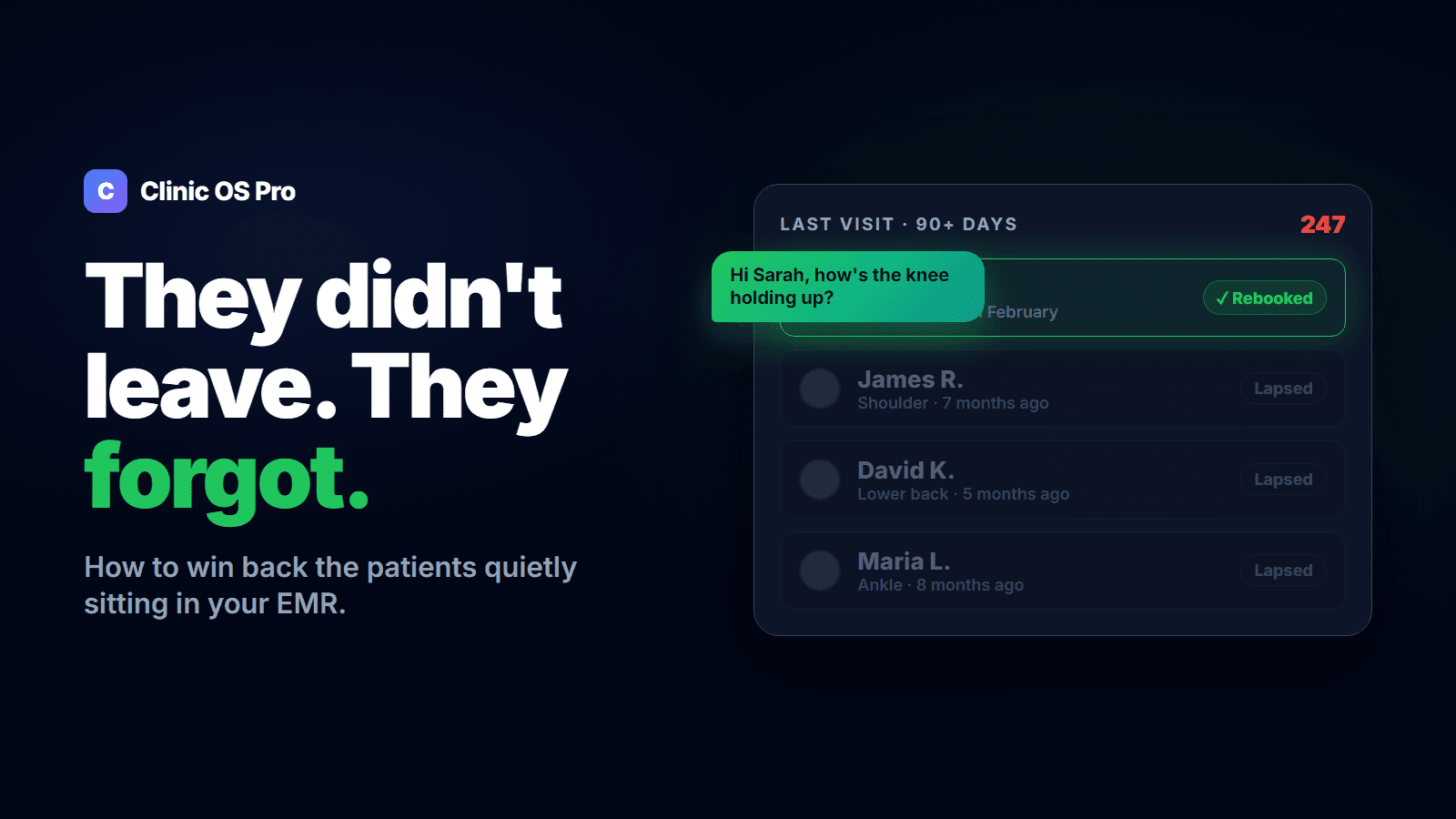
They Finished Every Visit. Then You Never Saw Them Again.
Retention reports catch patients who failed. Patients who finished care and never came back set off nothing. What that list is worth, and how to work it.
Pull up any retention report in your clinic. No-show list, cancellation report, the drop-off view your EMR calls something slightly different. Every one of them is built the same way: it catches a patient who failed to do something.
That is a reasonable way to build a report. It is also the reason your best patients are invisible.
A patient who attends all 12 prescribed visits, hits their goals and gets discharged sets off nothing. No missed appointment. No open balance. No gap in the schedule with their name on it. The chart closes, the episode reads complete, and every number in the building agrees it went well.
It did go well. That is not the same as it being finished.
ℹ️ Note
The short version. Reactivation chases patients who dropped out. Nobody works the list of patients who completed. Those people attended every visit, got the result and left on good terms, which makes them the warmest list in your building and the only one with no competition for it. The reason it sits untouched is that discharge closes a chart, and nothing in your software treats the silence afterwards as an event worth flagging.
Nothing in the system is watching
Your EMR knows the patient was discharged. It does not know they never came back, because it was never asked to care.
Discharge is a closing action. It ends the episode of care, files the note and moves the chart out of the active list. From the software's point of view the job finished correctly, so there is nothing left to monitor. Six months of silence afterwards is not a data point. It is just the absence of a new one.
Compare that to a patient who stops at visit 4. That one at least leaves a mark: an unfilled slot, a plan that never closed, a number that looks wrong if anyone goes looking. It is still easy to miss, but there is something to miss.
The discharged patient leaves nothing behind. Which is why every clinic I have looked at has a reactivation process of some kind, however loose, and no recall process at all.
Discharged is a status, not a prognosis
Here is the part worth sitting with. Your own discharge note usually says the quiet bit out loud.
Most of them include some version of continue the home exercise program, and return if symptoms recur. That sentence assumes two things: that the patient will keep doing the exercises without supervision, and that if the problem returns they will pick up the phone.
Read it honestly. It is a plan that depends entirely on the patient. Here is how that plan performs when researchers actually follow people after discharge.
| The discharge note assumes | What the research found |
|---|---|
| They keep doing the home exercise program | 37% had stopped doing it, despite 90% having been given one, in a survey of 556 adults over 65 with balance problems (Physical Therapy, 2006) |
| The problem is resolved | 69% of people who had recovered from low back pain had a recurrence within 12 months (da Silva et al., 2019) |
| They will call you if it comes back | 41% of the whole group sought care for a recurrence, from any provider, so roughly 4 in 10 recurrences went without care (same cohort) |
A systematic review of acute low back pain (15 studies) found 73% of patients had at least one recurrence within 12 months (Pengel et al., BMJ, 2003). Whatever number you take, recurrence is the normal course, not the exception.
A rotator cuff that took eight weeks to settle is not a solved problem. A chronic low back that finally got quiet is a thing that got quiet. The clinician knows that, which is why the note says what it says. Nobody actually thinks discharge means cured forever. It means this episode is done.
The gap is not clinical. It is that nothing turns the clinician's own expectation into a follow-up.
Why this list beats the patients who quit on you
Everybody wants to chase the patients who stopped coming: the ones who booked a plan of care and disappeared halfway through. That is worth doing. But think about who is actually on that list.
Someone who stopped at visit 5 stopped for a reason. Maybe the schedule got hard. Maybe the co-pay added up. Maybe they started feeling better and quietly decided it was enough. Maybe, occasionally, they did not think it was helping. You do not know which, and the message that wins them back has to work around all of it.
Now think about the discharged patient. They came to every appointment you asked for. They did the work. They finished, they got the outcome, and somebody shook their hand on the way out.
There is no objection to overcome. There is no bad experience to apologize around. There is no unpaid balance. The last interaction was a good one, and if you ask them today what they thought of your clinic, they will tell you it was great.
They are also the patients you would most want back in the building. They complete plans. They show up. Your utilization does not suffer when they are on the schedule.
And absolutely nobody is contacting them.
The word is recall, and it matters
Reactivation and recall get used interchangeably, and they should not be.
Reactivation goes after a plan that broke. You are trying to restart something that stopped.
Recall goes after a plan that worked. You are checking whether the result held, at an interval the clinician picks, and offering a visit if it did not.
Dentistry has done this for decades and nobody finds it strange. You get a card, you get a text, you come in every six months. No dental practice waits for a patient to notice a problem and call. The recall interval is set at the end of the appointment and the system does the rest.
Physical therapy treats conditions that recur, prescribes home exercise programs that decay without supervision, and discharges people with an instruction to come back if it flares. Then it waits by the phone.
12 visits attended
Everything you prescribed. The chart closes and the episode reads complete.
Months of silence
No report counts this. It is the absence of a data point, not a data point.
It comes back
For most people it does, and most of them do not call anyone.
What the gap is actually worth
I am going to model this rather than quote a study at you, because I have not seen a credible published figure and I am not going to invent one.
Take a clinic doing 60 initial evaluations a month. Say half of those plans complete, which is roughly the band clinics land in when they actually measure it. That is about 30 discharged patients a month, 360 a year.
Every one of those is a person who finished their care with you and heard nothing since.
💡 Tip
The one number to pull. Sort your EMR by discharge date, filter to patients discharged 6 to 12 months ago, and count them. That is the list. You do not need any new software to produce it, and most owners have never seen it.
Run your own figures rather than mine. The point is not the total. It is that the list already exists, it cost you nothing to build, and right now it is worth zero because nobody has ever contacted it.
What to do about it
Set the interval at discharge, not later. The clinician who wrote the plan knows whether this is a three month or a twelve month problem. That judgement is worth capturing while it is fresh, in the chart, at the moment the episode closes. Left until later it becomes a decision nobody has time to make.
Write it as a check-in, not an offer. The message that works asks how they are doing and says the door is open, with no body part or condition in writing. It is a reasonable thing for a clinic to ask a former patient, it does not read as marketing, and it gives them an easy way to say actually, it has been bothering me again. Save the shoulder for the phone call.
Let a no be a no. Some of them are genuinely fine. That is a good outcome and it should end the sequence, not trigger a second attempt. The whole advantage of this list is goodwill, and it is not hard to spend that.
Make it automatic. This is the part that decides whether it happens. Every clinic that runs recall by hand stops running recall by about week three, because the front desk is busy with today and this list is about six months ago. It has to fire on its own or it will not fire.
Clinic OS Pro handles this end: discharge is a patient status, and a check-in can be scheduled off it at whatever interval the clinician sets, without anyone remembering to. But the mechanism is less important than the decision to treat discharge as the start of something rather than the end of it.
If you want to see what that list is worth before you build anything, the revenue calculator runs your own discharge and completion numbers rather than an average. It takes about ninety seconds and it is the same arithmetic as above, done for your clinic.
The uncomfortable version
You already own this list. You built it by doing good work. It is sitting in your EMR right now, sorted by discharge date, and it is the only marketing asset you have that cost you nothing and that no competitor can touch.
It is worth exactly nothing until somebody sends the first message.
Frequently asked questions
What is patient recall in a PT clinic? Contacting a patient who completed their plan of care and was discharged, at a set interval afterwards, to check how the problem is holding up and offer a visit if it is not. It is different from reactivation, which chases patients who stopped attending part way through a plan. Recall targets people who finished.
How is recall different from reactivation? The patient's state when they left. A reactivation target dropped out mid-plan, so something went wrong: the schedule, the cost, the sense that it had stopped working. A recall target attended every prescribed visit, got the result, and was formally discharged. Nothing went wrong, which is why nothing flagged them, and why they are usually easier to bring back.
How long after discharge should you contact a patient? It depends on the condition, and the clinician who wrote the plan is the one who should decide. A post-surgical knee and a chronic low back are on different clocks. What matters more than the exact interval is that one gets set at discharge rather than left to whoever remembers.
Does my EMR track discharged patients who never returned? It records the discharge. It does not usually treat the silence afterwards as an event. Discharge closes the episode of care, the chart looks complete, and no report is built to ask what happened six months later. That is the reason the list stays unworked, not carelessness on the front desk.
Is contacting discharged patients allowed under HIPAA? Contacting your own former patients about their care is treatment and healthcare operations communication, which is standard practice. Marketing rules are stricter than care-related follow-up, so a check-in about their condition sits on firmer ground than a promotion does. Make that check-in a phone call: a text about their condition puts clinical detail where you don't control it. Confirm your own approach with whoever handles your compliance.
Between Patients Newsletter
One short email every Tuesday morning on getting more revenue out of the patients your clinic already has. No fluff, no pitch decks.
Free. Unsubscribe in one click, anytime.

Written by Ben Wiebe
Founder of Clinic OS Pro. Helps owner-led sports & ortho PT clinics cut no-shows, complete more plans of care, and bring back lapsed patients, from the EMR they already have.
Ready to Stop Leaving Revenue on the Table?
Two ways to get started: