They Didn't Leave Angry. They Forgot: Why Lapsed Patients Don't Come Back (and the Message That Wins Them Back)
Most lapsed PT patients didn't have a bad experience, they drifted. Why they don't return on their own, and the message that gets a reply.
You know the name. They were in twice a week back in February, working through a knee that was finally turning a corner. Then they stopped. You assume they found someone else, or didn't need you anymore.
Usually, neither is true. They just forgot.
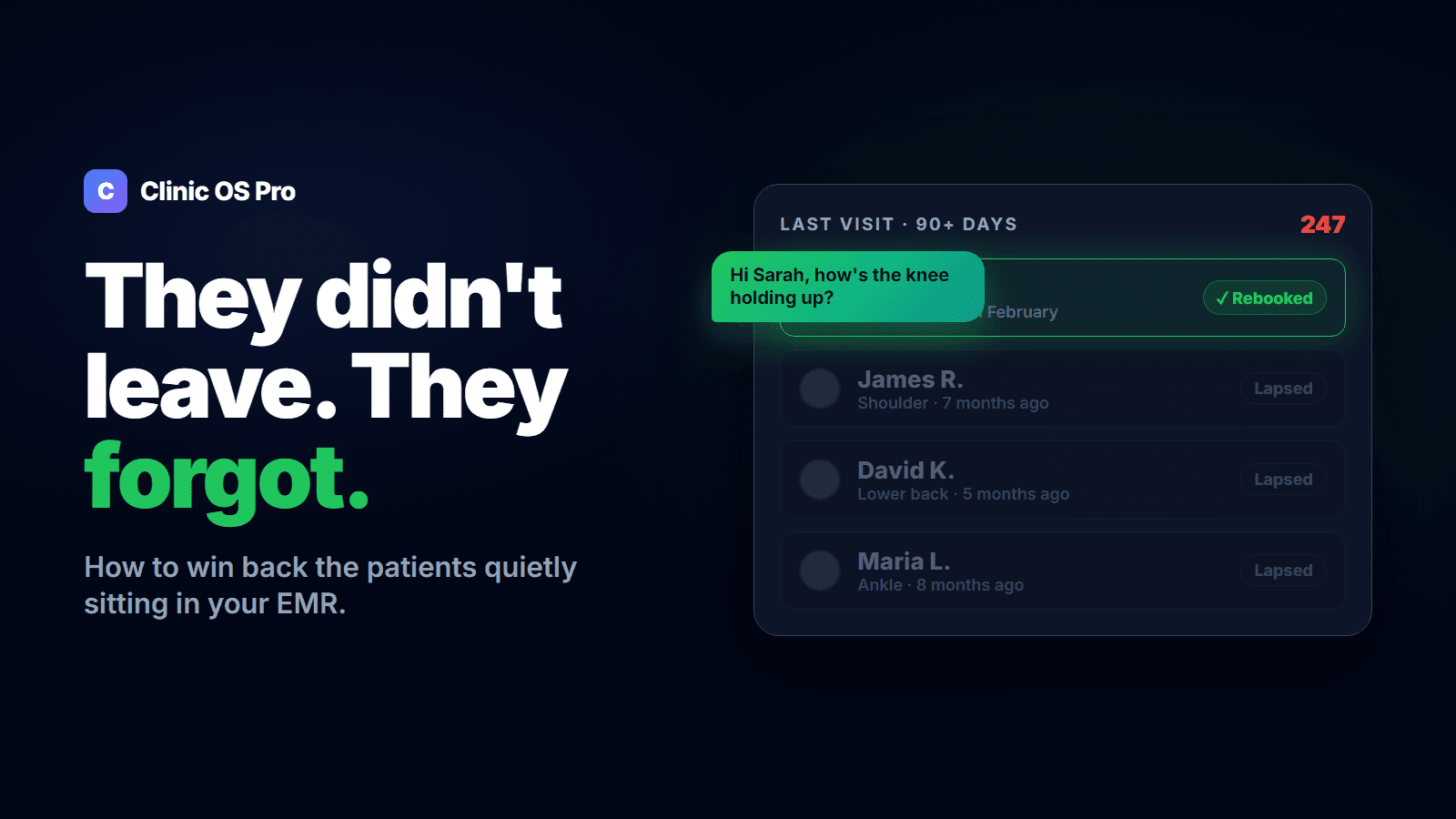
Lapsed patients didn't leave. They drifted.
The patient who disappears rarely had a bad experience. They started feeling better, work got busy, a kid got sick, and the next appointment never got booked. No decision, no complaint. The relationship didn't end. It just went quiet.
That matters, because it means they are not a lost cause. They are the warmest list you own: people who already trusted you, already know where you are, and in many cases still have a problem that is not actually fixed.
Why they don't come back on their own
Three reasons, and none of them are about you:
- Out of sight. You are not on their mind until the pain is. By then they may book with whoever shows up first in a search.
- They think they're fine. "Feeling better" is not "finished." The plan stopped at visit 6 of 12, and the underlying issue is still there, waiting to flare.
- Rebooking is friction. Calling, finding a time, remembering. Small barriers are enough to keep a busy person from doing something that doesn't feel urgent.
This is not a loyalty problem. It is a follow-up problem. And follow-up is something you control.
Why "We miss you, come back!" doesn't work
Most reactivation attempts are one generic blast: "We miss you. Book your next appointment today." It flops because it is about the clinic, not the patient. No reason, no relevance, and it still leaves them to do the work of rebooking.
A message that gets a reply does three things:
- It comes from a person. Send it from the therapist who actually treated them, by name. "It's Dan from [Clinic]" outperforms a clinic-wide "We miss you," because the patient remembers Dan.
- It gives a reason now. Remind them the plan was not finished, or that a check-in now beats a setback later. Give them a why that is about them, not your schedule.
- It removes the friction. One tap to rebook. A link, not a phone-tag invitation.
Here is a version that works:
"Hi Sarah, it's Dan from [Clinic]. It's been about six months since we wrapped up, and a lot of people who stopped where you did find things creep back. If anything's been bothering you, want me to grab you a spot this week? [link]"
A named therapist, a real reason, one tap. That is the whole game.
Keep the clinical detail out of the text
Notice what that message does not say. It does not name the body part, the injury, or the treatment.
That is deliberate, and it is the part most reactivation advice gets wrong. Text messages and ordinary email are not encrypted end to end. The moment you write "your shoulder impingement" or "how's the knee," you have put clinical information into a channel you do not control, sitting on a phone that might be unlocked on a kitchen counter.
You do not need it anyway. The personalisation that actually drives replies is who the message is from, not how much it knows. A note from the therapist who treated them reads as personal even with no clinical detail at all. A message that recites their diagnosis reads like a database wrote it, which it did.
So the rule is simple: the therapist's name in, the diagnosis out. Keep the specifics for the conversation once they are back in the room.
⚠️ Warning
Before you send anything to a lapsed list, check your templates against this. Every one of these shows up in real clinic reactivation campaigns.
- Never write the diagnosis, body part, or treatment in a text or email. "Your shoulder impingement" and "how's the knee" are both protected health information in an unencrypted channel.
- Keep voicemails generic too. A voicemail gets played on speaker in a kitchen. Leave your name, your clinic, and a callback number, nothing else.
- Don't reply from a shared clinic inbox that staff without a need to know can read.
- Don't run it from a personal phone. If a patient replies with clinical detail, that reply now lives on a device outside your control.
- Do get consent on file. A patient can agree to be contacted by text or email after you have explained the risk, and that agreement belongs in their record. It is also what lets you keep using the channel at all.
The part most advice skips: unencrypted contact is not forbidden. It is permitted once the patient has been warned and has agreed. What is never fine is putting clinical detail into that channel by default, before anyone has asked them.
Verbal conversation is different. A phone call between a provider and their patient is explicitly allowed to cover treatment, so that is where the specifics belong.
Timing beats volume
You do not have to message everyone at once. The patients most likely to say yes are the ones hitting a natural trigger: the new year, the start of a season, or the months before their insurance deductible resets. Reach the right patient at the right moment and a quiet list turns into a booked week.
The catch: you can't do this by hand
One thoughtful, personal, well-timed message is easy. Doing it for the 200+ lapsed patients sitting in your EMR, at the right moment, with the follow-ups, is not. That is the part that never gets done, which is exactly why the revenue stays buried.
That is what Clinic OS Pro runs for you: it surfaces who has gone quiet, sends the personal win-back message at the right time, and makes rebooking one tap, without your front desk lifting a finger.
If you want the full cadence rather than a single message, the 4-touch reactivation sequence has the day-by-day version. If you are weighing tools to run it, the reactivation software comparison covers the field.
Start with the number
Before you write a single message, find out what that quiet list is actually worth. It takes about 90 seconds.
Find your clinic's hidden revenue →
Frequently asked questions
Why do physical therapy patients stop coming before they finish? Most stop because they started feeling better, not because they were unhappy. Pain usually resolves before function is fully restored, so a patient who feels fine at visit six assumes the job is done. There is no decision and no complaint, which is why nothing in the clinic flags it.
What should a reactivation message actually say? Three things: send it from the therapist who treated them by name, give them a reason that is about them rather than your schedule, and make rebooking one tap. A generic 'we miss you' fails because it is about the clinic, and it still leaves the patient to do the work of rebooking.
Is it safe to text patients about coming back? Yes, provided you keep clinical detail out of the message. Text and ordinary email are not encrypted end to end, so naming a diagnosis, body part, or treatment puts protected health information into a channel you do not control. Send it from the treating therapist by name and reference the time since their last visit instead. That is both safer and more effective, because the personalisation that drives replies is who the message is from, not how much it knows.
How long should I wait before contacting a lapsed patient? Timing matters more than volume. The strongest moments are natural triggers: the start of a season, the new year, or the months before an insurance deductible resets. A patient reached at the right moment responds far better than the same patient reached at random.
Is it awkward to contact a patient who stopped coming? It feels awkward if you frame it as a sales call. It is not one. The patient has an incomplete plan of care, and following up on that is clinical follow-up rather than marketing. Framed that way, the conversation is straightforward for both sides.
Why can't my front desk just do this manually? They can, for about a week. One thoughtful, well-timed message is easy; doing it for 200 or more lapsed patients at the right moment, with follow-ups, is not. It is the task that gets dropped first on a busy day, which is exactly why the revenue stays buried.
Between Patients Newsletter
One short email every Tuesday morning on getting more revenue out of the patients your clinic already has. No fluff, no pitch decks.
Free. Unsubscribe in one click, anytime.

Written by Ben Wiebe
Founder of Clinic OS Pro. Helps owner-led sports & ortho PT clinics cut no-shows, complete more plans of care, and bring back lapsed patients, from the EMR they already have.
Ready to Stop Leaving Revenue on the Table?
Two ways to get started: